
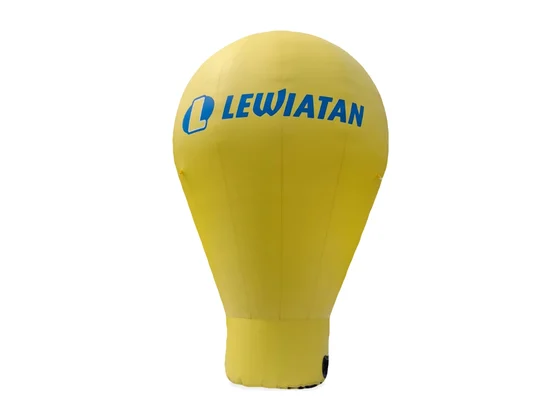
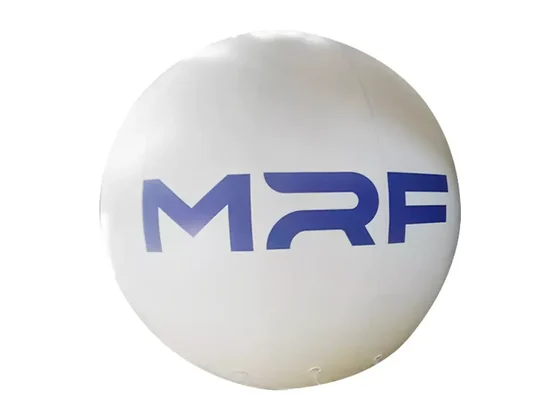
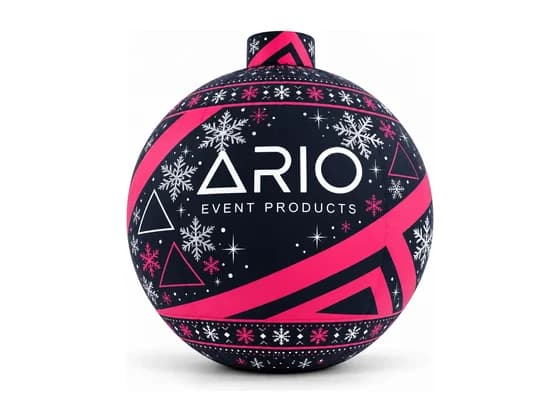
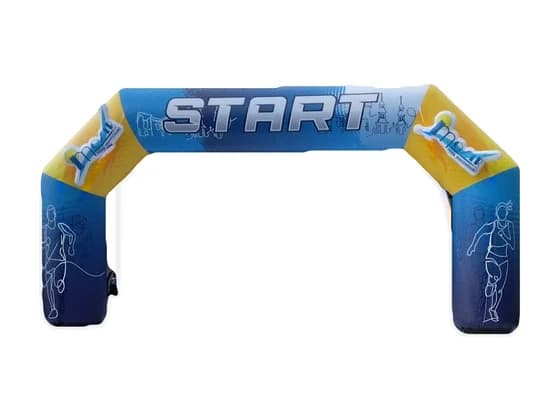

UV printing or dye sublimation
Why tents, arches and balloons are printed with UV inks while flags are sublimated – and what it means for durability, colour and lead time.
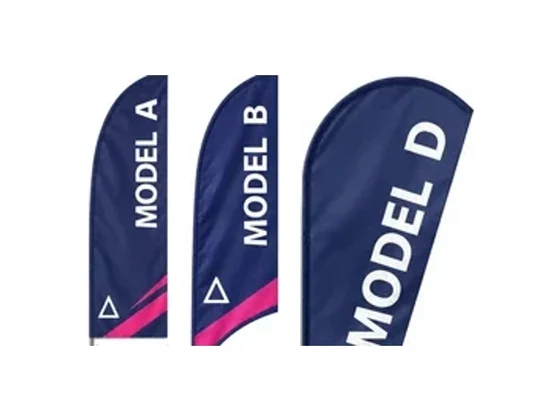
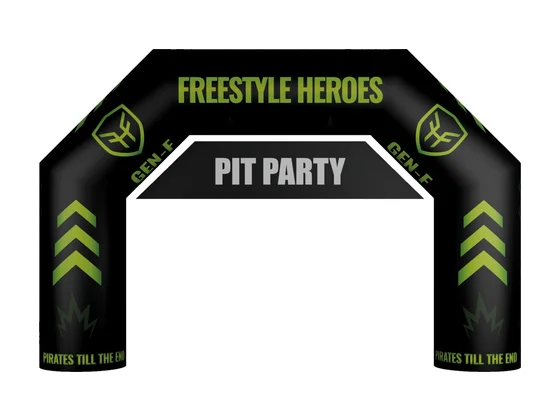
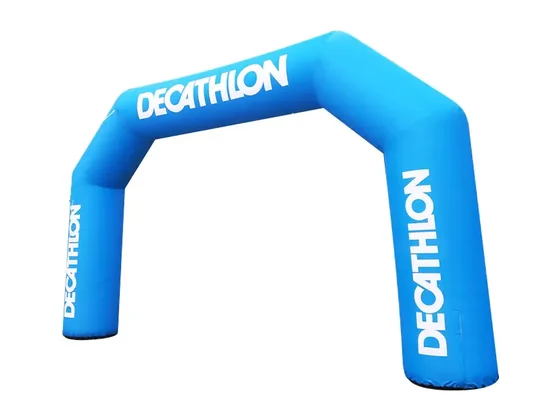
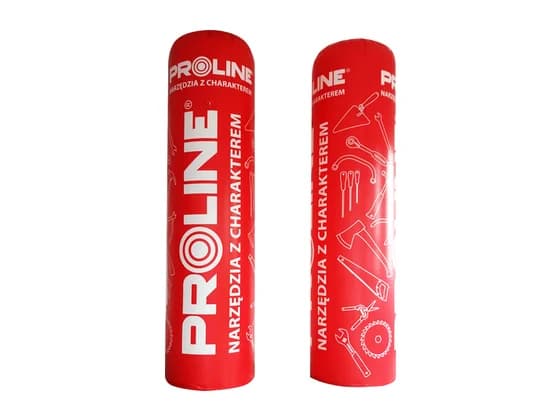
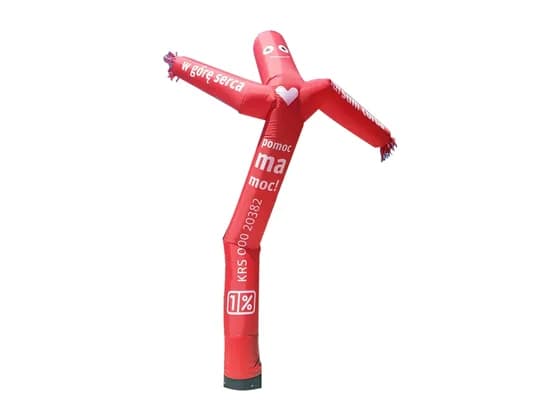
The print technique is chosen by the material, not by the price list. Dye sublimation needs 190–215 °C, while PVC-coated polyester starts to degrade at 150–180 °C – which is why we print tents, arches and balloons with UV-curable ink, and flags and feather banners made of spinnaker fabric by dye sublimation.
Two techniques, two different phenomena
In UV printing the ink stays on the surface and hardens in a fraction of a second under a lamp. In dye sublimation the dye turns into a gas, penetrates deep into the polyester fibre and is locked inside it as the fabric cools. These are not two variants of the same process.
Why dye sublimation cannot be done on PVC-coated fabric
Sublimation is not a matter of preference but of physics. Dye only turns into a gas at around 190–215 °C, and the press holds the fabric at 204 °C for 35–40 seconds. PVC, meanwhile, softens at about 80 °C and begins to break down above 150–180 °C. The process window of one technique ends where the window of the other begins.
Subliming a graphic onto tent skin would mean heating it to a temperature at which the PVC coating is already breaking down. For these fabrics UV printing is therefore not the cheaper or more convenient option – it is the only one on the table.
The material picks the technique, not the other way round
A smooth, continuous coating is a textbook substrate for UV-curable ink: the layer bonds to it both mechanically and chemically, and curing takes a fraction of a second. Sublimation is ruled out by temperature.
A thin, breathable fabric has to work in the wind and roll up tight. Dye inside the fibre forms no layer that could crack, and with direct printing the colour bleeds through to the reverse – which on a flag is what you see from either side.
What UV printing actually gives you
It prints on what sublimation will not touch
PVC-coated polyester, mesh, films, rigid boards. The bond is adhesive, so it needs no chemical affinity with the substrate – unlike dye, which has to penetrate the polyester.
Opaque white and varnish
Sublimation inks are transparent and have no white channel – artwork can only be laid down on light-coloured material. UV printing has opaque white and varnish, so it also works on dyed fabric and on dark backgrounds.
One stage instead of two
The print is cured before it leaves the machine and goes straight to finishing. Sublimation means printing onto transfer paper and then calendering – a second machine, a second pass and extra time.
Almost nothing is wasted
In UV printing over 90% of the ink ends up on the print. In sublimation about half the dye stays on the transfer paper or evaporates.
Pigment holds its colour in the sun
UV ink is pigment based, and pigment withstands radiation better than dye. Manufacturers' warranties quote 2–3 years of vertical exposure without lamination in our climate zone, and several years more with lamination.
No solvents
Cured UV ink releases no volatile organic compounds; the ink sets of leading manufacturers are GREENGUARD Gold certified. There is no solvent evaporation stage in the process.
In fairness: sublimation wins wherever it works on its own material. The print sits inside the fibre, so there is nothing to scratch or peel off, the fabric stays soft and breathable, and with direct printing the colour bleeds through to the reverse at 70–90%. That is why we do not print flags with UV, even where we could.
The two techniques compared point by point
| Feature | UV printing | Dye sublimation |
|---|---|---|
| Where the print sits | a layer on the surface | dye inside the fibre |
| Substrate | PVC-coated polyester, mesh, films, boards | uncoated polyester only |
| Process temperature | ambient temperature | 190–215 °C |
| Number of stages | one, cured in a fraction of a second | two: print onto paper, then calender |
| White and special colours | opaque white, varnish, printing on dark | no white, light substrates only |
| Colour bleed-through to the reverse | none | 70–90% with direct printing |
| Feel of the fabric | a layer you can feel | handle unchanged, the fabric breathes |
| Abrasion resistance | good, the layer can be damaged | very high, there is nothing to rub off |
| Colour in the sun | pigment; 2–3 years without lamination in manufacturers' warranties | dye; first visible change from a few months to about two years |
| Ink usage | over 90% | about 50% |
What customers ask about printing
Does UV print crack when the tent is folded?
Why do you print flags by sublimation if UV printing is more modern?
Does UV print fade in the sun?
Does higher resolution mean a better print?
Can artwork be sublimated onto a finished tent?
What about the smell and the safety of the print?
Sources
The figures on this page come from ink and machine manufacturers, from industry associations and from the literature on PVC degradation. We list them so that they can be checked rather than taken on trust.
Ask about printing your artwork- Mimaki – how UV ink works (curing, composition, substrates)
- PRINTING United Alliance – Digital Textile Primer (the sublimation mechanism, UV resistance)
- Sawgrass – heat press settings for sublimation (204 °C, 35–40 s)
- Thermal degradation of PVC: a review (ScienceDirect) – PVC breaks down from 150–180 °C
- 3M – MCS warranty matrix for printers using UV inks
- EFI – ink warranty (2 years without varnish, 5 with varnish, definition of fading)
- Marabu Ultra Jet DLE-JX – 2 years of vertical exposure in a central European climate
- Kiian Digital – sublimation ink data sheet with ISO 105-B02 ratings per colour
- Endutex – PVC-coated fabrics and the inks compatible with them (sublimation is not on the list)
- Roland DGA – ECO-UV inks (opaque white, varnish, 220% elongation)
- Advanced Textiles Association – UV printing on textiles versus the lightfastness of sublimation
- Textile World – colour bleed-through in direct printing and in transfer
- Signageworks – what resolution is enough at a given viewing distance